

Are school phone bans working?
Plus: a decline in youth suicide rates and all about health influencers

5 min read
Hello, sapiens! Maycember1 has arrived!
We’ve got graduations. We’ve got proms. We’ve got sports practices and exams and school talent shows and end-of-year parties. We’ve got baking cookies for the bake sale and tracking down “festive socks” for school spirit week and buying teacher gifts and shuttling between baseball games and birthday parties and spring carnivals and—Are you not entertained?!2
Anyway, we’ve all got a lot on our plates, so let’s hit the highlights today: a roundup of important new studies.
1. School phone bans are…working? Kind of?
This study has been everywhere and depending where you read about it, it either proves that school phone bans have been a total failure or a major success. So let’s take a look!
Researchers from the National Bureau of Economic Research partnered with Yondr, a company that sells lockable pouches for phones, which many schools use to implement phones bans. This was a “quasi-experimental” study. This means that, even though schools were not randomly assigned to use Yondr or not, researchers were able to compare schools that used Yondr pouches with very similar schools that did not. They looked at data from thousands of schools from 2018 to 2025 (excluding pandemic years 2020 and 2021) and found:
Yondr pouches did decrease phone use, according to GPS data that tracked device activity.
In surveys, teachers and parents were generally supportive of Yondr pouches; students were not.
In the first year after Yondr pouch adoption, disciplinary incidents increased (according to school records), including 16% more suspensions. This effect faded in future years.
In the first year after Yondr pouch adoption, student well-being declined, then rebounded and actually improved by the end of the second year.
Yondr pouches had zero effect on test scores over the first 3 years after Yondr pouch adoption.
They also had basically no effect on: attendance, students’ perceptions of how often online bullying was happening, and students’ self-reported classroom attention.
My take: This is an extremely impressive study—so many schools! So many datasets! GPS tracking, school records, surveys, test scores! These are the types of studies we need to start getting real answers on the effects of our tech-related policies. That said, as usual, I think the headlines around this study (“School cell phone bans don’t work!”) are missing some context.
First of all, this study does not look at state or school district-wide policy changes. It does not tell us whether these laws are or are not effective. Second, it looks at a very specific type of phone “ban” (Yondr pouches), so we don’t know about other types of bans. Third, we only have data for about 3 years post-adoption of Yondr pouches which, when it comes to changing things like test scores, is not very long.
Ultimately, I believe phone bans are generally a good idea. I also do not think they are going to solve everything. To me, this study—in combination with all the other research we have on phones in schools—supports that conclusion.3 NBER.
2. Some good news on youth mental health
We see a lot of news about rising rates of mental health concerns in young people, so it’s also important to pay attention when trends might be moving in the other direction.
For many years, the U.S. had a 10-digit phone number people could call when they were facing a suicide-related crisis. But in July 2022, the country launched the “988 Suicide and Crisis Lifeline,” allowing people to simply dial “988.” Alongside this, $1.5 billion dollars were spent to expand the capacity of these crisis centers.
This study used the National Vital Statistics System, a registry of all U.S. death certificates, to track rates of suicide deaths among people ages 15 to 34 from 1999 to 2024. From July 2022 (the launch of 988) to December 2024, the rate of suicide deaths decreased 11% (i.e., 4,372 fewer suicides) below expected numbers. And this rate was highest in states that had the highest uptake of 988 use.
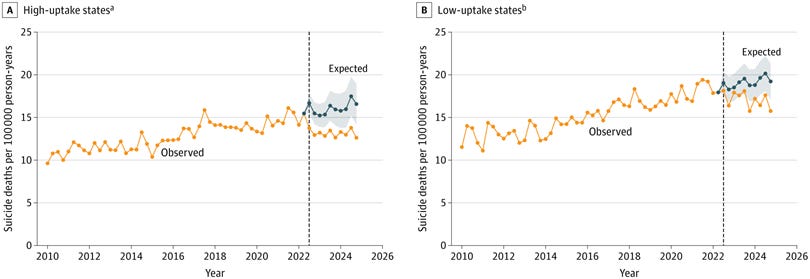
My take: I find this data to be really encouraging. The launch of 988 was a massive endeavor—financially and logistically—and this study offers some evidence that it is working. It’s especially encouraging to see that the states with the greatest decline in suicide rates were those with the strongest uptake of 988. It’s always nice to learn that our interventions are actually working and, in this case, even saving lives! JAMA.
3. Who are all these “health experts” on social media?
On a lighter note, we’ve got some interesting new data from Pew Research Center on the landscape of “health and wellness influencers” in the U.S.
First, the Pew team analyzed 12,800 social media accounts belonging to 6,828 influencers with over 100,000 followers on YouTube, Instagram, or TikTok. Then they surveyed over 10,000 U.S. adults about their experiences with these types of influencers.
Who are these influencers? According to their bios, 17% are conventional medical professionals (doctors, dentists, nurses), 7% are allied health professionals (physical therapists, pharmacists), 31% are “coaches,” 28% are “entrepreneurs,” and 16% have no credentials listed. Two-thirds (64%) are women.
And how much are we all turning to them for health and wellness information? A lot! 40% of all U.S. adults say they get information from these influencers or podcasts, and this is especially common among those under 50.
There are many reasons why we follow these people, but most people cite a desire to make a change to their lifestyle:
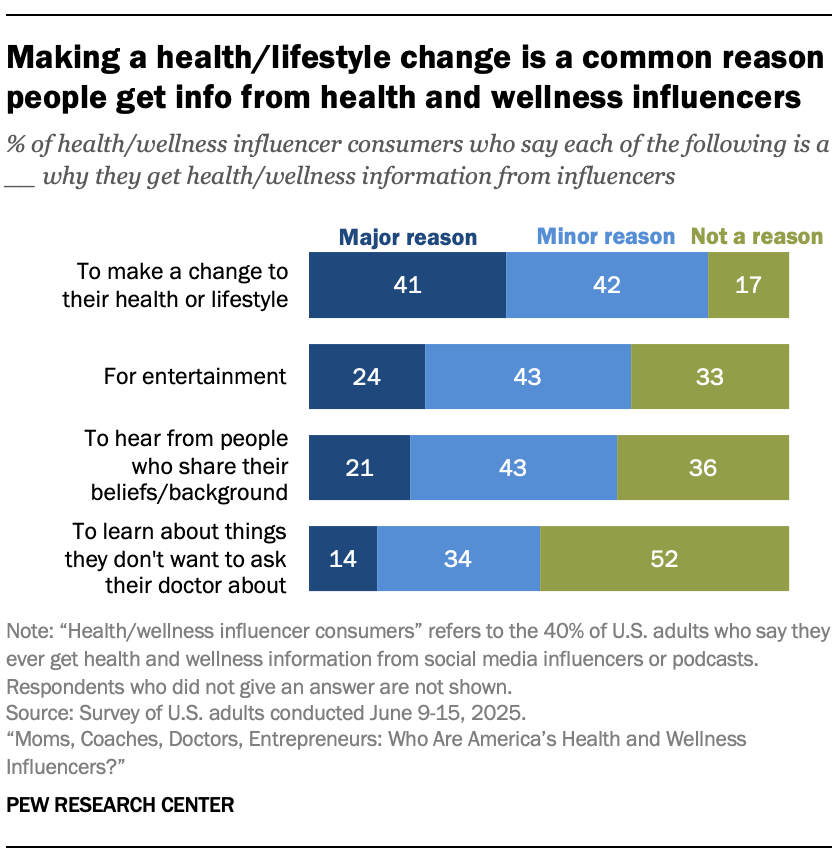
My take: First of all, I just love the idea of Pew researchers spending thousands of hours combing the bios of influencers.4 More importantly, their survey data suggests a wide range in how much trust people are putting in the health information they get from influencers: 10% say they trust “all or most” of the information, 65% say they trust “some” of it, and 24% say they trust “not too much or none.” I’d love to see the follow-up on that “some”—what types of information are we more likely to trust? When is this trust helpful, and when does it lead us astray? Pew Research Center.
Support Techno Sapiens
❤️ If you liked this post, give it a ❤️ so others can find it, too
📧 If you know someone who might like Techno Sapiens, forward this email along
🔓If you’re enjoying the newsletter, consider upgrading to a paid subscription
A quick survey
What did you think of this week’s Techno Sapiens? Your feedback helps me make this better. Thank you!
The Best | Great | Good | Meh | The Worst
Also referred to as the “100 days of May,” Maycember is the month in which all the end-of-year activities and general craziness take place—kind of like December, but with less festive cheer. My children are still too young for the full Maycember experience, but I can sense it creeping up on us, ready to spring into full force when elementary school arrives.
I never saw Gladiator, but I think this is probably what that scene was about? Right?
My husband has said that one of my redeeming qualities is that I am usually able to refrain from saying “I told you so” in situations where I did, in fact, tell someone so. Therefore, I will not say I told anyone so. But I did write the following in a post in 2024: “Phone bans won’t fix everything: Finally, it’s worth remembering that these policies are not a panacea…Bottom line: if we want students talking to each other during lunch, or paying attention during class, we need policies that ensure their phones are not distracting them during those times. But if we’re pinning our hopes for solving the mental health crisis on phone bans, we’re going to be disappointed.”
Would have loved to be a fly on the wall for the Pew researchers’ conversations with their spouses at the end of the day. i.e., Spouse: How was work today? Researcher: Oh, you know, just another 8-hour shift browsing YouTube. What are your thoughts on “Blogilates”?
This resonates with my clinical experience.
I work with suicidal youth on an inpatient psychiatric ward. We don't allow phones or social media. Kids themselves say the break helps them process their crisis. It works when the rules are universal and temporary — which is exactly the logic behind Ontario's classroom ban.
Kids are trained to think in headlines. But their emotions don't fit in one. They need the bandwidth to go deeper.
On the YouTube finding — I am one of those 17% of doctors on the platform but I am not much of an influencer with 474 subscribers. What I noticed is that YouTube rewards simple universal advice. You don't need medical school for that. The algorithm doesn't support layered analysis of a layered world.
That's what Substack is for.
The problem with that study is that phone bans work...pouches do not. Schools in UK that have implemented a full ban on all internet enabled devices on site with only simple phones allowed have seen significant changes. Yes anecdotal but this is head teachers saying this and sure studies will follow. Pouches are just pushed by that industry as a solution but they cost schools both time and money and keep the culture of owning smart phones so still have issues everywhere else