



How many 12-year-olds use TikTok?
Plus: more TikTok stats, news coverage of kids' online safety, and more

Hello, hello! It’s time for our very first 5-Minute Research Roundup of 2025.
For those who are new here (welcome!), Research Roundups are a monthly Techno Sapiens special. I read through the latest research on tech, psychology, and parenting, and then share what’s interesting, surprising, and important in 5 minutes or less.
It’s been a busy month in the world of social media and kids’ online safety, so today we have a special ~*themed*~ roundup. We’ve got research on:
Facts about U.S. TikTok use and views on the ban
How many kids under age 13 use social media? Which platforms?
How do mainstream news outlets talk about kids’ online safety?
Typically, Research Roundups are only for paid subscribers, but today it’s open to all. Thank you to paying subscribers who make this whole endeavor possible!
If you, too, want to support my efforts to share research in a way that’s accessible, balanced, and—dare I say it?—fun, please consider a paid subscription (20% off!).
Now, let’s get to it!
1. Is the clock ticking on TikTok?
In case you missed it: this weekend saw TikTok go dark in the U.S. after a federal TikTok law went into effect. The app was back a few hours later. What happens next for TikTok remains to be seen, so for now, let’s just manage the uncertainty by perusing some good, old-fashioned data.
These stats about TikTok in the U.S. come from a series of large, nationally-representative U.S. surveys conducted and compiled by our friend, our confidante, our guiding light: Pew Research Center.
As of summer 2024, 32% of Americans said they support a U.S. TikTok ban.
Slightly fewer Americans (28%) opposed the ban, and the highest proportion (39%) were not sure.
33% of U.S. adults use TikTok (but 59% of adults ages 18-29).
Among teens ages 13-17, 63% use TikTok, and 57% say they use it daily
Among adult TikTok users, 95% use it for entertainment, 65% to connect with others or share interest, and 41% to get news
My take: I will not offer any political analysis—many others have that covered—but I will say, simply, it’s hard to overstate TikTok’s influence on nearly every aspect of our lives. TikTok’s future remains uncertain, but one thing we can certainly count on? Many more “clock ticking” TikTok pun headlines. Pew Research Center.
2. How many kids 12 and under use social media?
Thanks to Pew, we have data on social media use among teens and adults. But what about younger kids? Technically, many platforms do not allow users under the age of 13 (this rule comes from the Children’s Online Privacy Protection Rule, or COPPA), but anyone who has spent time within 100 feet of a 12-year-old can tell you that this is not exactly enforced by the platforms.
This study used data from a massive, ongoing national study called the Adolescent Brain Cognitive Development study (ABCD), with a sample of 10,092 11- to 15-year-olds.
Among kids under age 13 (i.e., 11- and 12-year-olds), they found:
63.8% reported using social media
They had an average of 3.38 social media accounts
Among the 63.8% with a social media account, TikTok was most popular, with 68.2% saying they have an account. 57.3% said they have Instagram and 55.2% Snapchat
Only 5.4% said their social media account(s) were secret from their parents
My take: The takeaway here is simple: a lot of kids are using social media! This data may slightly overestimate the numbers, given data collection during the pandemic (2019-2021), when rates of social media use may have been higher. But still: 64% using social media! Despite a national desire to put our fingers in our ears and scream “la-la-la,” kids under 13 are using these platforms. We need to either do a better job of preventing that, or make the platforms safer for kids that age. Academic Pediatrics.
3. What do we hear about kids’ online safety in the news?
Speaking of kids’ online safety, I was on a panel at the (excellent) Technology and Adolescent Mental Wellness Colloquium last week. You know it was a good conference because the Zoom chat was extremely active with people sharing links to academic articles, of which I frantically clicked as many as possible. This article is the result of one such link (whose origin, unfortunately, I can no longer remember given my aforementioned frantic clicking).
Anyway! In this fascinating study, researchers systematically searched a list of 10 news media outlets in the U.S. (see table) for articles written about kids’ online safety and privacy. This resulted in 157 relevant articles published between 2020 and 2024. The researchers then painstakingly reviewed each article, identifying themes in how kids’ online safety was discussed.
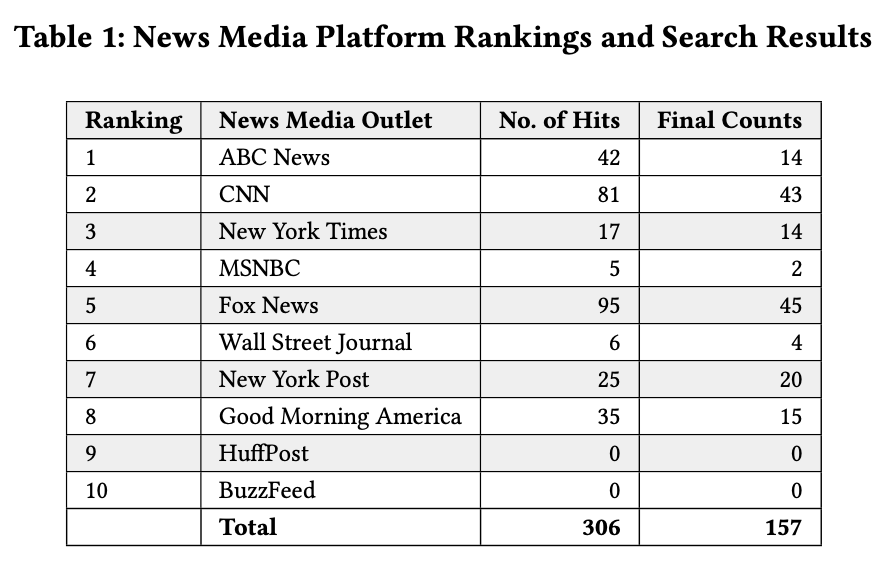
They found three common narratives in these articles:
Strong focus on negative online experiences (with a tone of fear) and mental health concerns. This included many stories about sexual-related risks, privacy risks, exposure to inappropriate content, and harassment.
Emphasis on restrictive practices to prevent risks. There was lots of discussion of parental controls and limits, and of legislative efforts to restrict teens’ online access.
Lack of youth perspectives. A “negligible fraction” of articles included opinions or perspectives from youth themselves.
My take: Admittedly, this article was catnip for me. In the past year or two, I’ve gotten slightly obsessed with the idea of “narratives” about social media and youth safety. What are parents (and kids themselves) hearing about how the online world impacts them? I worry a narrative that exclusively promotes fear, while ignoring any potential benefits and leaving kids out of the conversation altogether, is…not the best approach. One potential first step? Work to counteract this narrative with balanced, accurate “digital literacy” education for both parents and kids. We’ll keep fighting the good fight here at Techno Sapiens! CSCW
A quick survey
What did you think of this week’s Techno Sapiens? Your feedback helps me make this better. Thanks!
Thought-provoking as always. I do think it's pretty important to separate out what the messaging should be to parents, vs. the messaging to kids.
To kids, I think we (the ones out here in public discourse, resisting the default cultural opt-in to 100% social media saturation and advocating a more thoughtful approach—can I generalize we TechnoSapiens as that?) should spend more time showing rather than telling kids what they're missing, and gently but firmly pointing back to history (what were your grandparents capable of at age 17? how about *their* grandparents? what has made you believe you're not capable? etc.) and examples of what we might aspire to or avoid. You catch more flies with honey, now as ever. And tbh, they learn more by watching what you DO by than listening to what you SAY. If you're living life everyday in the real world, relatively happy and healthy and not hanging bleary-eyed on every hot take of the moment, chances are they'll notice that and (eventually) connect it to how you spend your time differently than the rest of the miserable hulking masses. 😝
To parents, I think we need to emphatically punt the tired "Well everybody else is doing it, and it would require, like actual effort to assert even a tiny semblance of a rule in my household" narrative into the stratosphere. The fact is, you have agency. And you are making a clear decision, today and every day, as to how technology's used in your house and on devices you provide. Whether you want to acknowledge it or not is on you. I recognize that not every parent will come up with the same expectations in their household as I have, and that's okay! But I think there needs to be a push toward intentionality and accountability. Putcha grown-up pants on. We can do hard things.
And while there's not always a bright line separating those two spheres, I agree that neither is served by sensationalism and hyperbolic language. That said, I think this is one of the few topics that's serious enough that just stating the information and giving verifiable examples can be shocking enough. It's not sensationalism if what's being reported really IS that serious.
Re: news coverage, it's less interesting to me whether sensationalist language / a "tone of fear" is being used around social media topics and more interesting to know whether it's any *more* sensationalist than other topics. I mean, pick a headline, any headline. In just about any mainstream media outlet, about just about all the topics, they're so hyperbolic that they're becoming straight-up meaningless. So I don't see a reason to think that this arena is any worse. My instinct is it's following the general trend that's exactly what online monetization biases for: "Hey if we make this outrage-inducing, people will click on it more! So let's make everything outrage-inducing, ALL THE TIME!" This is certainly not unique to social media discourse. I don't even think it's part of some big evil plan. It's just simply how they make more money. It's how they make the graph go up and to the right. So of course they've been doing it as much as possible, lo these many years.
I'm interested in hearing what youths have to say about the topic, and that *has* been surveyed and reported on in popular sources (they have mixed feelings at best). But I don't think they should necessarily be driving the discussion. As with "whether or not only ice cream for dinner is fine and good," and "whether or not we should totally go get matchy tattoos together right now with all our 12yo friends," the answers can be predictable and short-sighted. It's still important for there to be grown-ups in the room. Social media is full of things that Cannot Be Unseen (ask me how I know), and there are some things that kids can't properly consent to and rightfully so because.........they're kids.
As a 24-year-old girl I met at a party a couple months ago said after I mentioned I used to work at Tumblr, "Wow that site really did a number on me. I wish I had gotten a chance to be a kid longer. I grew up really fast. My mom just...had no idea, really."
I'm fresh off of watching The Social Dilemma (2020) https://thesocialdilemma.com/ and am feeling pretty spooked about social media in general, and I'm saying this as someone who posts regularly on TikTok! I'm also a social scientist using TikTok to research medical conversations. But the thing that I'm struggling with is how Tech companies are incentivized to maintain ours and our kids' attention within the apps, which is documented in The Social Dilemma. The upshot being that we're a species captivated by moving pictures and easily manipulated, and that our digital native kids aren't able to have enough reference points outside of this paradigm to envision an alternative (I'm not fully sold on that point). But it feels like an updated warning of Gil-Scott Heron's "The revolution will not be televised," which is a powerful and relevant contestation of our evolving screen-based culture.
In discussions with the college students I teach in gen ed English, they have been unanimous in their desire for some top-down regulation on social media. They confess to basically feeling hurt/damaged/confused by their on/off addictions to social media apps and they wish there was political will behind limiting their exposure to them in the first place. I was completely surprised by this narrative when I heard it across a number of student led discussions.
I'll be the first to say that I've genuinely connected with people on TikTok. I've had a number of off-app text threads, phone calls, and zoom meetings because of the app. When I thought it was going away on Sunday, I downloaded all my content, comments, and transcripts for my research, too, only to reopen the app less than 24 hours later to a hyperpoliticized message that appeared to reiterate the thesis of The Social Dilemma, which is that although these platforms seem to offer positive benefits toward human connection, there is a much more sinister agenda at play related to political polarization and social control.
This is all leading up to my question, which is, have you seen The Social Dilemma? And is there any research in your world about the implications of the social infrastructure of these apps on our kids, rather than just their immediate impacts from viewing time or types of content consumed? Maybe restating this... are there "big picture" critiques people in your field have about social media? I know you're a psychologist, not a political scientist, but I'm curious about if this aspect of social media is brought up?