


Welcome back to Techno Sapiens! I’m Jacqueline Nesi, a clinical psychologist, professor, and mom of three whose idea of a spooky Halloween post is one about fear-based digital parenting. 🎃
6 min read
Most nights, after the workday has ended, dinner has been made, the children have been corralled to the table, and food has been halfheartedly picked at, the real work begins. In the midst of dinner cleanup, with our one-year-old screeching to be set free from her high chair, it’s time to start the bedtime routine.
My two boys (ages 5 and 3) need to clear their plates, wash their hands, brush their teeth, and put on pajamas. I realize this does not sound like a lot. I can assure you, it is.1
Inevitably, at some point during the process, one of them recognizes an opportunity.
Mom, they ask, Do we have time to watch something?
Often, if the bedtime routine has not gone totally off the rails, the answer is yes. We can watch a show before reading some books and heading to bed. Sometimes, though, the answer is no.
And when the answer is no, there is a reaction.
Why not?!
Please, please, please, pleeeeease?!
No!!!
This is often accompanied by tears, raised voices, and burying faces in the couch pillows (theirs, not mine…unfortunately).
In these moments, a number of thoughts go through my head. On good days, I tell myself things like: This is a good learning opportunity for them. Or It’s okay for them to feel disappointed. Or This is a normal reaction, and it will pass.
On bad days, other thoughts creep in. What does this say about them, or about my parenting? Are they too attached—even addicted—to the TV? Am I doing irreparable damage to their brains?
Given that thinking through these issues is, actually, my entire job, I can usually reassure myself with the evidence. Some screen time is fine, not dangerous, and learning to regulate feelings around it is a normal part of kids’ development.2
So, I try to acknowledge how they’re feeling (I know that’s disappointing), hold the limit (not tonight), and move on—peeling a small body off the couch, wiping a bead of sweat from my forehead, and diving into another read of The Magic School Bus.3
That is the power of mindsets.
The Techno Sapien-est study there ever was
Today we’re talking about a new study published in Technology, Mind, & Behavior called Parents’ views about teens and tech: parents have more to gain from a trust-based digital mindset versus one driven by fear.
The study looks at parents’ “mindsets,” or beliefs, attitudes, and assumptions about technology, and how those mindsets relate to their behaviors and their teens’ experiences.
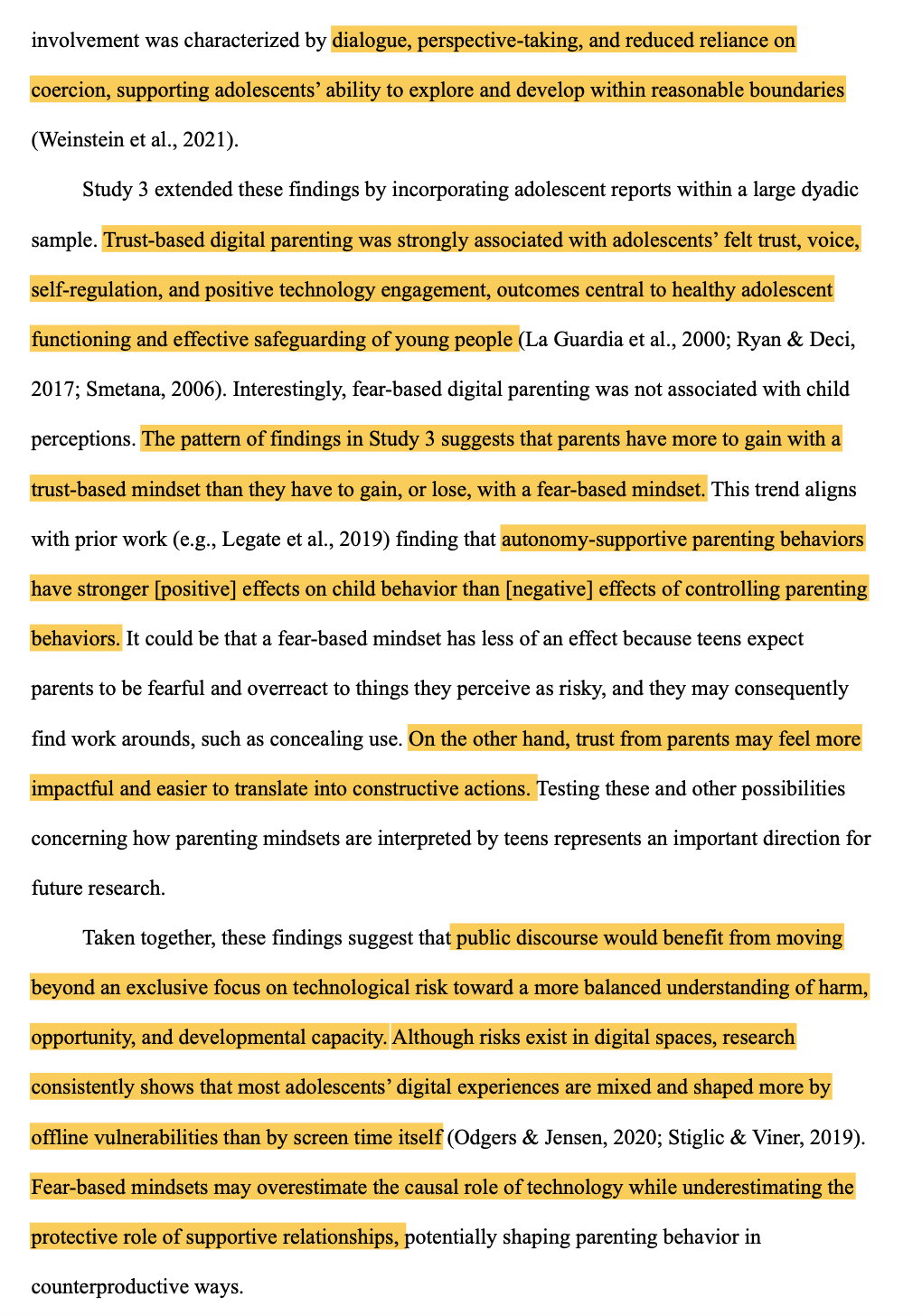
Could there be a more perfect fit for Techno Sapiens? I will let my highly ineffective highlighting pattern answer that.4
What did the researchers do?
First, they developed surveys to assess “fear-based” versus “trust-based” digital parenting mindsets among parents of adolescents (roughly ages 10 to 16).
Here are the scales they landed on, with all items rated on a scale from strongly disagree to strongly agree:
Fear-based digital parenting mindset
Screen time is one of the biggest threats to children today
Screen time is leading to a decline in children’s well-being
Screen use is dangerously addictive for children
Spending time on screens is harmful to a child’s developing brain
Screen time is destroying childhood
Screens are dangerous for my child
Trust-based digital parenting mindset
I trust that my child will learn to balance screen time with other activities
I believe my child will ultimately be capable of managing screen time responsibly
My child can make good decisions about screen time as they gain more experience with technology
My child can ultimately learn to manage screen time responsibly from making good and bad decisions now
The researchers then looked at how these mindsets were related to parenting behaviors, parenting styles, and adolescent functioning across two samples (both cross-sectional): 298 parents and 2,000 adolescent-parent pairs.5
What did they find?
Parents who had a more “trust-based” digital parenting mindset also showed a number of positive patterns:
Their teens reported feeling more trusted and that they had a voice
Their teens also reported better self-regulation and more positive use of technology
They used parenting practices that were more warm and responsive
Importantly, they were not overly permissive or disengaged. They were no less likely than other parents to monitor their kids’ digital activity and use parental controls.
Parents who had more “fear-based” mindsets did not experience these same benefits. They also saw some downsides. They felt less effective in their parenting and more stressed, and their behavior was more controlling.
The effects of trust-based mindsets were stronger than those of fear-based mindsets. As the authors sum up: “parents have more to gain with a trust-based mindset than they have to gain, or lose, with a fear-based mindset.”
Okay, what do I do with this information?
The first thing to do here is get clear on what “mindsets” actually are. Then we can try to shape them to be more helpful to us.
Mindsets are not feelings
A mindset is not a feeling or emotion. In fact, though I (obviously) love this study, my one gripe is with the term “fear-based mindset.” Fear is an emotion, and it’s normal to feel that! It makes sense that we might feel some anxiety or fear about our kids’ technology use.
A mindset is a set of beliefs or attitudes. It’s a “broad interpretive framework” that you can bring into everyday situations.
Mindsets shape behavior
Mindsets shape how we interpret situations, which effects our behavior. For example, when my children are melting down over not watching TV, I can come to this with very different mindsets.
If my existing mindset is something like “Screen use is dangerously addictive for children,” I might interpret their meltdowns as a crisis: a sign that something is horribly wrong with them or my parenting, and that I need to take extreme measures (e.g., punish them, ban all screens) to solve the problem. I’ll probably also feel stressed, anxious, and unsure.
On the other hand, if my mindset is something more like “I trust that my child will learn to balance screen time with other activities,” I’ll have a different approach. I might recognize the meltdown for what it is—a developmentally appropriate response to my “no”—and (hopefully) respond in more productive ways (e.g., validating the feeling, holding the boundary).
This research makes clear: a trust-based mindset doesn’t mean we ignore the risks of technology, or that we let our kids loose to figure it out on their own, without supervision or rules.
Rather, it means that we take a realistic view of the risks and challenges of technology. It also means we recognize our children’s capacity to navigate those challenges with our support, to make mistakes and learn from them, and to grow more capable over time.
Mindsets are not static
So the question is, can we change our mindsets?
Luckily, a body of existing research suggests the answer is yes. Even brief educational interventions can change how we think about ourselves and the world.
So, a good place to start is to consider the messages we tend to get—from the media, from our communities, from scary Substack headlines—about the dangers of technology for our children. The message we so often get as parents is that technology is something to fear, and that we need to be constantly vigilant about its dangers.
But we can, and should, take a step back to question this message: where does it come from? Is it true? Is it useful?
When faced with the many decisions we make each day about our kids and technology, we can aim for a more nuanced mindset: yes, there are risks, but with support, guidance, and trust, we can help our kids thrive.
A quick survey
What did you think of this week’s Techno Sapiens? Your feedback helps me make this better. Thank you!
The Best | Great | Good | Meh | The Worst
Support Techno Sapiens (and the human who writes it)
❤️ If you liked this post, give it a ❤️ so others can find it, too
📧 If you know someone who might like Techno Sapiens, forward this email along
🔓 If you found this helpful, please consider upgrading to a paid subscription
I once ran a marathon, and I think the period from 6 to 7 pm with young children is harder than that. Why won’t they brush their teeth? Why are they all screaming at the same time? Why is one of them always scampering around the house with no pants on?
To be clear, if there were major, consistent tantrums happening over this screen-time set up, I’d re-evaluate, but for now, it’s mostly working for us. On the plus side, it allows me to get the Octonauts theme song stuck in my head just in time to echo in my brain on an endless loop as I try to fall asleep.
We’ve recently gotten into the original The Magic School Bus books in my house, and I’m happy to confirm that they absolutely hold up! Can we bring this series back? I would love to see Ms. Frizzle and the gang travel inside an AI model and write up some class projects on computer science.
In case you needed further proof that a real human is researching and writing this newsletter.
One important caveat to these findings was that the study was cross-sectional (i.e., data was collected at a single time point). This means we don’t know what was causing what. I suspect that kids who were already engaging in more problematic technology use were more likely to have parents who developed fear-based mindsets. However, I don’t think that’s the whole story.
Except the study (or at least this reporting on it) doesn’t tell us anything about the trusted kids’ ACTUAL online habits or whether they are harming them… it only says that group FEELS more trusted/heard and like they can self regulate. Self regulation to a 15 year old might mean they are on TikTok until midnight instead of 1am like their friends.
Trust? When deliberate persuasive design has been built into tech platforms to intentionally addict your kids? When your kids are being actively recruited by groups such as "764"? (Look it up! Or ask your local FBI agents!) When Roblox developers deliberately create games mapping real life tragedies or recruit young people into extremist groups (again, ask FBI agents)? Yes, trust your kids offline - but the online environment truly is fraught with danger. Parents - just don't buy the devices, or lock them up. Your kids will have a one week withdrawal period, indicating addiction and then your family life will vastly improve as you converse, play games, sing, enjoy nature, and all of the other real world activities that truly enrich life. And you will see your kids improve in mood, attention and social skills. Ask anyone (like me) who has had CLINICAL EXPERIENCE with thousands of kids.