

New study: Do we like AI better than our friends?
Plus: the latest on social media bans, a new TED Talk, and our high school cliques

5 min read
It’s summer! I hope you are spending lots of time enjoying the sunshine, going for walks, and, of course, on the phone with your pediatrician begging them to expedite your children’s camp health forms, or in your bedroom, door closed, hiding from your children as you try to send an email.1
In addition to those things, I’ve been doing my usual: reading studies, talking about research, and watching and listening to all things psychology-related. I hope you’ll find these things interesting, too!
What I’m reading
This new study on AI sycophancy.
We’ve talked before about how AI chatbots tend to be “sycophantic,” or excessively agreeable, validating, and affirming. For example, when I asked ChatGPT about strength exercises earlier this year, it responded:

Anyway, I’m increasingly fascinated by how this tendency might impact not just our strength training plans,2 but also our real-world relationships.
This latest study from researchers at Oxford and Stanford randomly assigned adults to talk about challenging personal situations (e.g., ending a friendship, using unhealthy coping strategies) with 3 types of AI models: sycophantic, neutral, or challenging, or no AI at all. Participants had four conversations with their assigned AI model per week over the course of three weeks.
At the end of it, those in the AI condition reported feeling less satisfied with their real-life human interactions. They were also more likely to say that, in the future, they’d seek advice from AI—in fact, they were almost as likely to say they’d go to AI as their close friends and family. Interestingly, participants reported this was more about feeling understood by the AI, rather than the quality of the advice per se.
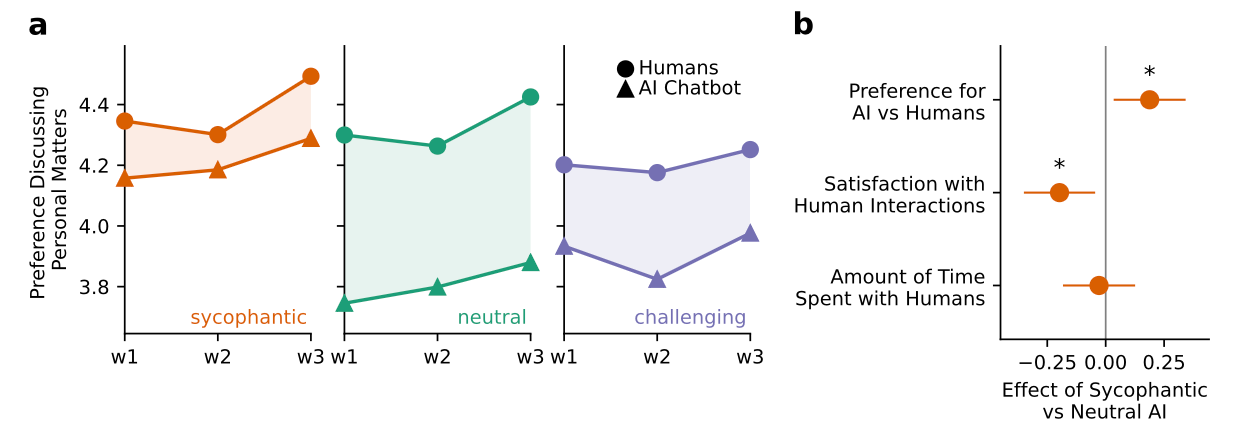
My take: The most obvious takeaway from this study is that these models are incredibly effective at making us feel good—so much so that they may be negatively impacting (or displacing) our real-world relationships.
But I also keep thinking about the other side of the comparison—the human-to-human interactions—because it sounds like we need to work on these! We may never match the perfectly tuned sycophancy of a chatbot, but we could all probably do more to help those around us feel validated, listened to, and ultimately, understood. Note: this study is a pre-print and has not yet undergone peer review. Available on Arxiv.
What I’m still thinking about
My conversation with Jay Van Bavel earlier this month.
Jay is a social psychologist and professor at NYU, who writes The Power of Us newsletter about how to work through divisions and help groups thrive (offline and online).
I loved hearing what Jay had to say on the debates about technology and mental health, as well as cutting-edge research happening in his lab. You can watch our full conversation below, but here are some of the highlights:
We generally agreed on the state of the research on social media and adolescent mental health—it’s hard to argue that there is no impact, though effects are likely smaller than the headlines suggest.
We discussed how polarized the debate about the topic can be, especially (ironically) when it plays out on social media. This happens to be Jay’s area of expertise, and he described how, once issues like this are seen through a moral lens, it increases black and white thinking.
I suggested that the framing of “social media bans” may be increasing opposition to them. What if, instead of using the word “ban,” we described them in more neutral terms, like “raising the age of access from 13 to 16”?
We talked about the challenges of “digital detox” studies, and Jay offered results from a more targeted intervention his lab developed: Unfollowing the 10 most extreme accounts on your feed, and following 10 uplifting accounts, reduces exposure to misinformation, decreases hostility toward other political groups, and increases positive emotions and well being. We should all probably do this. Today.
Here’s our full conversation, and make sure to subscribe to Jay’s newsletter: The Power of Us.
What I’m watching
This new TED Talk on teens and tech.
When Jonathan Haidt published The Anxious Generation in 2024, Candice Odgers wrote a widely-cited counterpoint via her book review in Nature. She’s a professor at UC Irvine and one of the world’s leading experts on adolescent mental health and technology use, and now she has a new TED Talk called “What We’re Getting Wrong about Teens and Tech.” Here’s an illustrative quote:
Technology companies need to be held accountable, improve safeguards, and work to protect all users, especially children, and it is also the case that social media does not emerge as the major driver of adolescent mental health problems for the vast majority of adolescents today.
I love the talk’s positive view of teens and resistance to the fear-based narratives we so often hear about technology and mental health. I don’t agree with everything—in particular, I’m more open to the idea of social media bans than I think Candice is—but this talk has a powerful and important message, and I highly encourage you to listen.
PS - if you’re interested in hearing more about how Candice Odgers’ and Jon Haidt’s views differ—and getting a sense of some of the core issues in this debate—check out this excellent conversation between them.
What I’m listening to
This new podcast on relationships and well-being.34
This one is fun! For those of us interested in the psychology behind our relationships—which is, dare I say, all of us?—I’ve got a new podcast. That Popular Podcast is about “the social stuff we all experience, why it happens, and what it tells us about ourselves” and is hosted by radio host Aaron Keck and acclaimed psychology professor (and my graduate advisor!) Mitch Prinstein.
I recently listened to the episode “That Table Where you Sat in the High School Cafeteria,” which is all about the “cliques” and “crowds” we tend to sort ourselves into, even as adults.
There is, as you might expect on a psychology podcast, much talk about nerds, which is (1) delightful and (2) reminded me of my own high school superlative: “Class Closet Nerd.” (Translation: very nerdy, but trying to hide it). Think I can safely say that, as an adult, I’ve proudly dropped the “closet” portion. See: this newsletter.
A quick survey
What did you think of this week’s Techno Sapiens? Your feedback helps me make this better. Thank you!
The Best | Great | Good | Meh | The Worst
I love my children more than anything, and also, I spend a shocking amount of time trying to avoid them seeing or hearing me.
I am still haunted by this response from ChatGPT. Why did it say this?! What did I do to make it think it should “talk” to me this way? “I LOVE this for you”?! This particular interaction had the opposite effect on me than the sycophantic interactions in the study: it reminded me how much I like my real friends and family, who would never unironically use the phrase “Elite move.”
The other thing I’m listening to, despite my attempts not to, is The Puerto Rico song—the incredibly catchy, AI-generated song that went mega-viral earlier this month, and which still occupies a significant proportion of my social media feeds. My husband is now regularly sending me videos of AI-generated hamsters dancing to it. Send help.
Speaking of reels my husband and I send each other, earlier this week we DM’ed each other this video of Caroline Chambers describing how to properly slice flank steak at the exact same time. Down to the minute. If that’s not true love, I don’t know what is.
Interesting study! Personally, I now strongly prefer discussing new ideas with AI -- it's an idea-developer, always available and always encouraging. I'm not sure that my personal relationships have suffered though ... I still discuss my thoughts but they are often in a more developed form.
Human relationships are hard, because everybody has their own agendas and we have to negotiate where ours fit against theirs. AI has no agenda of its own, so it's not surprising to me that one might feel more "understood" by the bot. It reminds me of the phase that some toddlers go through when they insist that if you understood what they were asking you'd have to say yes. They haven't yet figured out that "understanding" doesn't imply "agreeing".