

We don't need another warning about screens
New Surgeon General's advisory: The good, the bad, and the weird

Welcome back to Techno Sapiens! I’m Jacqueline Nesi, a psychologist, professor at Brown, and mom of three.
This post is about the U.S. Surgeon General’s advisory on screen time that came out last week. The substantive analysis is available to everyone. Below the paywall, you’ll find additional musings about some parts of the report that I found puzzling.
Thanks for being here, sapiens!
5 min read
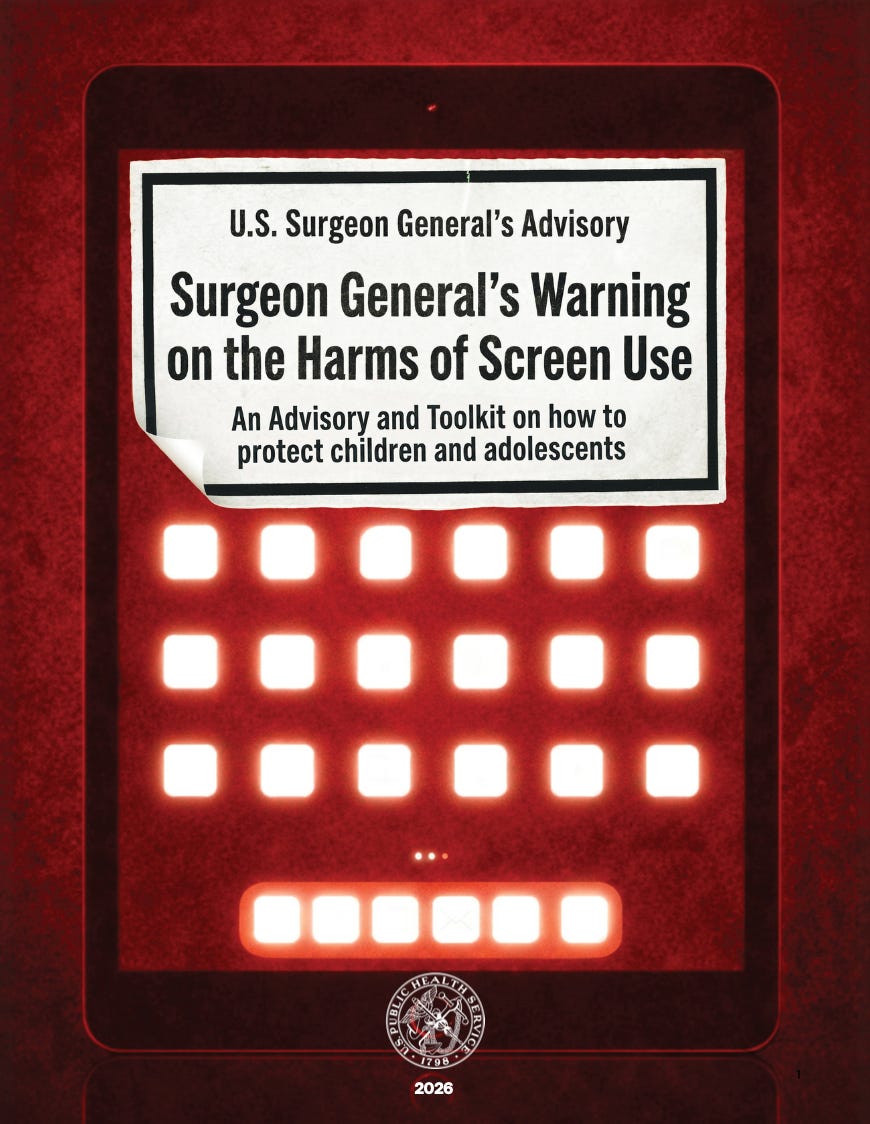
On Wednesday, May 20, the U.S. Office of the Surgeon General issued an advisory on the dangers of screen use for children and adolescents. It looks like this:
A Surgeon General’s Advisory is a “public statement that calls the American people’s attention to an urgent public health issue and provides recommendations for how it should be addressed.” Recent advisories, for example, have included warnings about: firearm violence (2024), parental stress and burnout (2024), loneliness and isolation (2024), and social media and youth mental health (2023).1
So what should we make of this one? Let’s take a look.
The good
The advisory calls attention to many of the challenges we talk about here at Techno Sapiens: the problematic design of many platforms made for children, excessive use of screens that interferes with children’s other activities, and disruption of youth sleep due to screen use.
The advisory also nicely summarizes a key takeaway from the research: that the effects of screens “depend on multiple factors, such as a child’s age, the types of screen use, the content viewed, the context of intended purpose, and what screen time may displace.”
And it notes that there are gaps in the research, with much of the existing work being correlational and relying on a range of different “screen time” measures.
Many of the recommendations in the report are common sense, reasonable guidelines that align with guidance from organizations like the American Academy of Pediatrics, American Psychological Association, and Common Sense Media. For example:
For parents: create a family media plan, model healthy screen use for your kids, practice screen-free times at home.
For policymakers: enact laws to protect child safety and privacy protection, fund research, and support access to public spaces like parks, playgrounds, after school programs, and libraries.
For schools: consider cell phone policies and teach digital literacy. There is also a handy checklist in the Toolkit for helping schools think through questions related to their phone policies.2
The bad
Despite initial statements about how the effects of screens depend on context (good!), the advisory then goes on to a 4-page bulleted list of “Negative Impacts of Screen Use,” with most of those impacts overstated, lacking nuance, or relying on cross-sectional research (not good!).
The report is also imprecise in how it discusses “harmful screen use.” At times, it is specific, suggesting that screen use becomes “harmful” when it is excessive, difficult to control, or involves exposure to problematic content (good!). Other times, though, it seems to suggest that any and all screen use is harmful (not good!).
Beyond this lack of precision, I also found some inaccuracies. For example, in a large graphic, the report cites a study saying that nearly 5 out of 10 teenagers have experienced cyberbullying. This statistic does not appear in the paper cited. That paper uses data from the 2023 Youth Risk Behavior Survey (YRBS). According to the 2023 YRBS, 16% of high school students reported being “electronically bullied” in the past year.
Overall, between the report’s list of negative impacts, the title (“Warning on the Harms of Screen Use”), and even the ominous-looking cover image, my concern is that this advisory will only amplify the anxiety and guilt that so many of us feel when it comes to kids’ screen use. No one makes their best decisions when they’re in the midst of hysteria—that includes parents, children, and policymakers.
I do not think we need another dire warning about screens. I think we need action to create an environment—in our homes, schools, and communities—where children can find a healthy balance of on- and off-screen activities, and where the adults in their lives have the resources and support to make that possible.
The weird
Alright, now I need to be honest. There is some weird stuff in this advisory. I have read the news coverage, and have seen no mention of this weirdness. I assume this is because other outlets are ~very serious news organizations~ and have more important things to worry about than odd grammatical and stylistic choices.
But sapiens, we are (thankfully) not a serious news organization, so we’re going to get into it.