

Everything you've heard about being a dad is wrong
An interview with Kevin Maguire, author of The New Fatherhood

Welcome to Techno Sapiens! I’m Jacqueline Nesi, a psychologist, professor, and mom of three who has often (until now!) lamented the lack of good books written for dads.
6 min read
Happy Monday, sapiens! It’s time for this month’s Q&A, and I could not be more excited to introduce our guest, Kevin Maguire, author of the incredible new book The New Fatherhood: Why Everything They Told You About Being A Dad is Wrong, and How Embracing It Will Transform Your Life.
I first found Kevin through his Substack The New Fatherhood, of which I’ve been a regular and enthusiastic reader for [according to a quick search of my Gmail] nearly 5 years. In other words, Kevin—without his knowledge—has been a constant companion through my entire parenting journey thus far. And for that I am very grateful.
I am not, you may have noticed, a father—but I love Kevin’s writing all the same. It is honest, funny, beautifully-crafted, and genuinely helpful to all parents. Whether or not you’re a dad yourself, I think you’ll agree.
You can grab your own copy of the book right here.
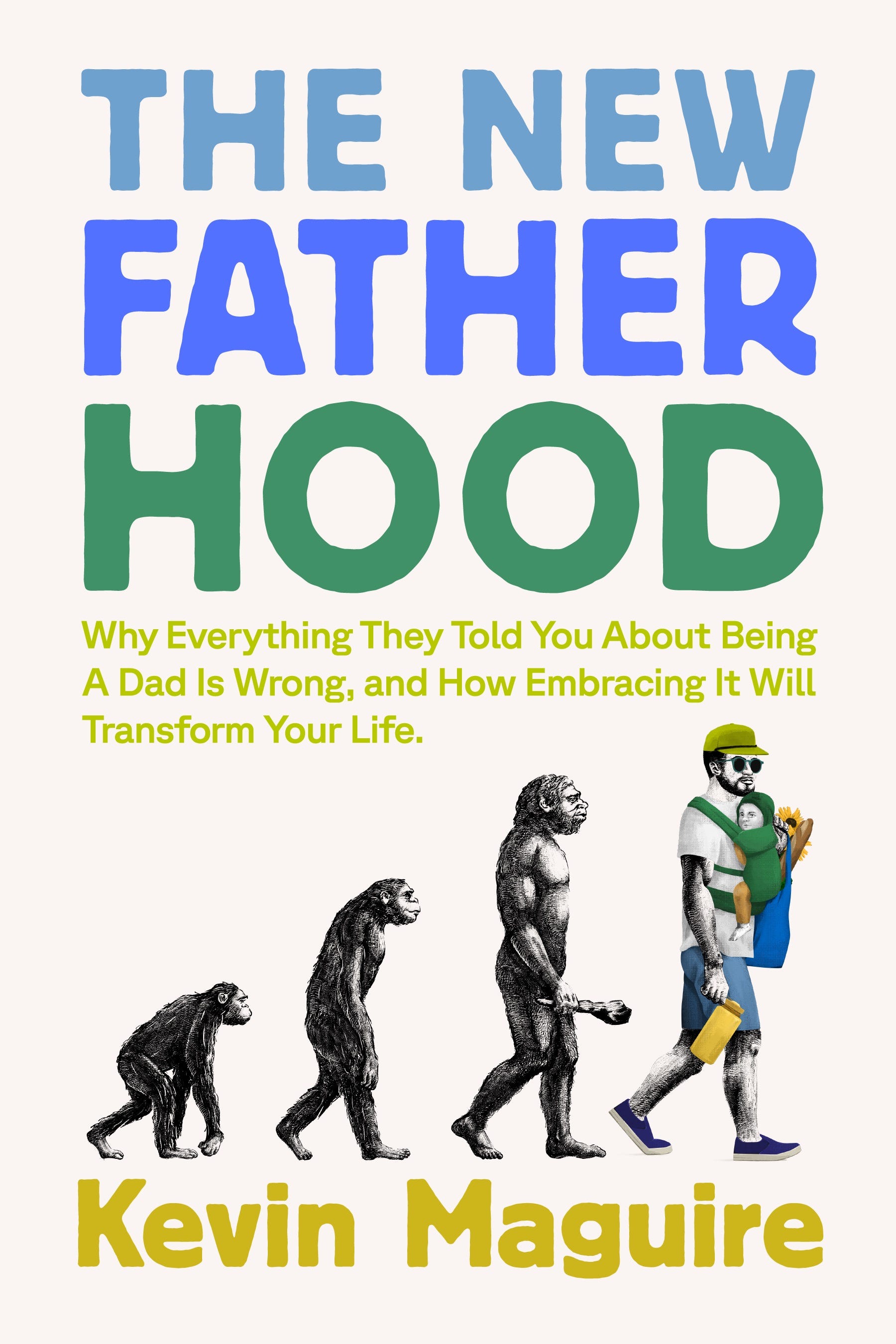
Finally, a book for dads! It seems like a lot of the parenting books out there are (either explicitly or implicitly) written for moms. I’m wondering — what inspired you to write this book? And did you get any pushback (from publishers or others) about writing a “fatherhood” book?
The first round of feedback from publishers was eerily consistent: dads don’t read books. With my focus group of one, I knew that wasn’t the case. And thanks to the 22,000 dads who read my newsletter every week, I know I had the stats to back me up. When I talk to dads about their reading habits, they share artefacts that have helped them navigate the trials and tribulations life throws their way: Atomic Habits, The Daily Stoic, Why Buddhism is True, Four Thousand Weeks; books all written by men after becoming dads.
But walking into a store, great dad books are an anomaly. The right book at the right moment can change who you think you can be. Fatherhood is exactly that moment, a time when we need all the help we can get. So the issue was never that dads don’t read: it’s that most fatherhood books aren’t worth their time, caught between dry how-to books and “survival guides” written in a tone that treats fatherhood as something that should by endured, not enjoyed.
(Sidenote: there is no shortage of great books by and for moms! I often tell dads reading a great motherhood memoir is akin to a cheat code to understanding the person you live with. Some of my favourites are Jacqueline Rose’s Mothers, Rachel Cusk’s A Life’s Work or Jessi Klein’s I’ll Show Myself Out.)
Dads deserve better than what’s available. So I wrote the book I wish someone would have handed me a decade ago.
Are there any common misconceptions people have about modern fatherhood?
The biggest one I hear constantly, including from dads themselves, is that the role of the dad is to simply support mom.
There has been a lot written in the last few years on the idea of weaponised incompetence: dads playing dumb to avoid the work. But even for dads who are genuinely trying to lean in and co-parent more equally, being relegated to a role of support sets a dangerous precedent.
Yes, men can be guilty of worshipping at the altar of untouchable motherhood, providing the convenient side effect of abdicating responsibility. But with this vicious cycle—less involvement leads to less confidence, less confidence brings less competence, less competence justifies less involvement—ultimately all roads lead away from richer relationships with your children.
Dads need to be given the space to step up, even if that means getting things wrong. When a father’s parenting approach differs from a mother’s—as it inevitably will—he may be corrected, critiqued, or simply nudged aside. “Don’t do it like that” can become a steady drumbeat in those early months, and while not malicious—rather deeply rooted in the pressure mothers face to get everything right—the impact can be profound, and sometimes irreversible.
There are only so many times you can be told you’re doing something wrong before you’ll stop trying to do it right, retreating into a peripheral role—the fun dad, the disciplinarian, the fixer-upper—reinforcing the very dynamics we are working to escape.
The research is now unambiguous that engaged fathering shapes children’s emotional regulation, academic outcomes, and long-term mental health—but in order to do that, dads need to be treated as primary attachment figures, not auxiliary ones.
What was the most surprising thing you learned while writing the book?
That the scientific research on fatherhood remains so thin on the ground. There are 259 citations in the back of this book, and when I wrote about adjacent topics—psychedelics, mindfulness, life fulfillment—there was a robust base of knowledge to draw on. But when the lens turns to how men are actually navigating modern fatherhood, the science hasn’t caught up yet with the stories I was hearing from the dads in my orbit.
Paternal Postpartum Depression (PPD) is the clearest example. I dealt with it myself after my son was born in 2019, and when I couldn’t find the help I needed, I started writing so that other dads might find it in the future. Five years and thousands of dad-emails later, I’m still hearing from new fathers who’ve never once been asked about their mental health, and the research echoes this.
When I first started writing about the topic, it was suggested anywhere between 4-25% of new dads would experience an episode—a frustratingly wide range, driven by the fact that medical professionals weren’t screening for it the way they do for new mothers, paired with the particular male urge to avoid the doctor wherever possible and a reluctance to open up when asked how they were doing. A meta-analysis later put the overall figure at roughly 10%, broadly comparable to the rate in new mothers.
But even those numbers are suspect, because the way we screen dads remains stuck in the past. The Edinburgh Postnatal Depression Scale was built for mothers, and men more often mask their distress through irritability, rage, or compulsive overworking than through typical sadness, so even when fathers are screened, the wrong instrument is often being used.
With such a lack of resources, for the publication of the book I partnered with a team of therapists and counsellors to create a check-up tool for new dads, drawing on the latest research.
The most surprising thing isn’t a single fact I discovered in my research, it’s how much we still don’t know, and how many dads out there are silently struggling whilst we try to find it out.
Being a parent is hard! What is one practical takeaway dads (and moms!) might put into practice right away to make things a little easier?
I wanted the book to be useful to every dad—whether they’ve been doing it for ten days or ten years. And one thing that has come up consistently, that I’ve had repeated back to me over the five years of writing the newsletter, is to be armed with a personal parenting mantra that you can reach to in a time of need. This might mean the difference between losing your temper and finding a capacity for empathy and understanding that you didn’t even know was there.
These are the three that I return to most regularly:
“This too shall pass.” Whatever stage you’re in—the sleep regression, the won’t-put-my-shoes-on morning meltdown, the fact your eldest is developing selective deafness every time you ask them to clean up after themselves—just remember, this won’t last forever.
The Last Time Meditation. This one is from philosophy professor William B. Irvine, who suggested: “When you’re doing something, you should reflect on the possibility that this might be the last time you do it.” For parents, this takes on another dimension: there will be a last time you’ll carry a sleeping kid out of the car and into their bed. A last time they’ll go up on your shoulders. A last time they’ll grab your hand crossing the street. And you’ll have no idea when the last time will be. I used to get so frustrated combing the knots out of my daughter’s hair, and I never would have thought that I’d look back and wish I could still do it.
“They’re not giving you a hard time, they’re having a hard time.” I use this one every week. When your kid is melting down, the easiest thing to do is pour fuel on the fire. And, especially for dads who don’t consider empathy as the strongest tool in their emotional utility belt, we can strive to stop a meltdown, rather than understand it. So this mantra becomes a reframe that provides an instant shot of compassion to the heart.
You can grab your own copy of The New Fatherhood here and sign up for the newsletter here!
A quick survey
What did you think of this week’s Techno Sapiens? Your feedback helps me make this better. Thank you!
As a long time reader of both technosapiens, the new fatherhood, and a fatherhood writer myself, I love how much positive energy this book brings. I hope it becomes one of those books to help alot of dads find their way into becoming the parent they want to be but never had the toolkit to make it there.
Great to find an author writing about modern fatherhood. I am absolutely a huge part of my children's emotional life. I am the chief comforter. I am in bed with each of them every night. While I have to be at work a lot, I spend 3 full days each week as primary carer and it shows! They treat me the same as their mum - as a primary source of security and comfort. So much of dad culture is lame avoidance. While there's 100% a unique approach to being a dad vs mum given biology differences and tendencies toward certain roles, it's no less involved if you want to engage. I am glad someone is writing about it.