

How to get your time back
Back awayyy from the Google calendar

Welcome back to Techno Sapiens! I’m Jacqueline Nesi, a psychologist and professor at Brown University and mom of two young kids, one of whom has insisted on a “purple recycling truck cake” for his 4th birthday.
If you like Techno Sapiens, please consider sharing it with a friend today!
5 min read
Last week, after a few blissful weeks away, my family and I came home. It will be nice to get back into a routine, my husband and I kept saying—like a rosary prayer we silently hoped would be fulfilled by sheer repetition.
The “routine,” it turns out, was chaos.
My Google calendar was a rainbow of time blocks, written with caps lock, tangled and overlapping.
There were errands (GET CAR SERVICED!) and urgent reminders (ORDER RECYCLING TRUCK BIRTHDAY CAKE!).1 There were swim lessons (my kids), meetings (me), and so many doctors appointments (kids and me).2 There was a forgotten camp form, a frantic printer installation to print it, and a race to the doctor’s office to beg for a 24-hour turnaround on signatures.
I’m told there was also a full-time job squeezed in there.
It was one of those weeks where the 24-hour day feels oppressively short. Where everything is hurried, and with each completed task, the to-do list only gets longer. Where there’s just not enough time.
Ti-i-ime why you punish me?
I was recently reminded that, as with all things in psychology, this experience has a name.3 Time poverty is “the chronic feeling of having too many things to do and not enough time to do them.”
Many people—as many as 80% of American adults—feel it, and it’s associated with worse well-being and poorer overall health.
There are, of course, many external factors that contribute to feelings of time poverty: changes in the nature of work, the accelerated speed of our daily lives due to the Internet, bureaucratic time burdens (e.g., for healthcare, childcare, and other essential services). There are also important differences by income: higher earners actually report greater feelings of time scarcity,4 but, importantly, more access to the resources needed to remedy it.
As I read about these societal and institutional drivers of time poverty, I found myself nodding along. Work productivity expectations *are* too high! And I *did* spend a double-digit number of hours trying to navigate the bureaucratic labyrinth of parental leave!
But then, I came across the other factors that contribute to time poverty. The psychological ones. The idea that we tend to undervalue our time, and neglect taking steps to protect it. That we forget to prioritize spending time on things that matter.
That our relationship with time is actually somewhat subjective, and may be more in our control than we realize.
And I don’t believe in time
You want to know the truth? At first, I wasn’t buying this whole “relationship with time is subjective” nonsense.
Yea, sure, psychologists, I’ll just change how I feel about the meeting I need to postpone because my child’s camp pickup is running late, and the 40 unread emails I’ll try to process while clad in a patient gown, waiting at the OB-GYN. No problem! **kicks nearby piece of furniture**
But now, I’m looking ahead to next week.
The research findings have slowly seeped into my consciousness. They’ve melted just enough of my resistance, and begrudgingly, I’ve decided to take a few, small steps to try decreasing my feelings of “time poverty.”
Would you like to join me?
(Time!) is wasting, (time!) is walking
The opposite of “time poverty” is, of course, time affluence: having enough time for the tasks you need and want to do, and not feeling hurried or pressured.
Apparently, there are people out there who experience this, and they’re more likely to feel happier and more satisfied with their relationships, work, and lives overall.
For the rest of us, there are things we can do to get closer. Here are three simple, research-backed strategies to cultivate time affluence.
1. Take back control of your calendar
According to Laurie Santos, Yale professor and expert in the science of happiness: “Never underestimate the power of a tiny, little block of extra free time.” Take a moment—right now, if you’re feeling bold!—and look at your schedule for this week. Can you find an hour? 30 minutes? Even 15 minutes? Block that time off, and plan to use it for something you want to do.
Research also suggests that mindfulness is an important component of feeling more time affluent. In one study, people who improved their mindfulness skills through an 8-week mindfulness intervention (versus a control group) reported increased feelings of time affluence (e.g., “I have had enough time to do the things that are important to me.”)
So, when we’re spending that “tiny, little block” of time doing the thing we want to do, it may help to practice keeping our attention on the present moment. Focus on what we’re doing, on the sights and sounds, on how it feels to take time for ourselves. This “mindful awareness” can lead to a “subjectively slower passage of time.”
For what it’s worth, I’ve blocked off one hour this week to go for a walk around a local state park. It is, of course, on my calendar in all caps (WALK TO INCREASE TIME AFFLUENCE).
2. Give time to others
This one is counterintuitive, but the research does not lie!
In a 2012 study titled “Giving Time Gives you Time,” researchers had participants come into a lab and assigned them to: (1) go home early, or (2) do something nice for someone else (in this case, edit an essay for an at-risk student at a local high school). Even though going home early objectively increased participants’ spare time, those assigned to help the local student felt less time constrained.
This may be because helping others increases our sense of “self-efficacy,” so we feel more capable, confident, and able to get things done going forward.
So, make a plan to spend time (in the 2012 study, it was just 15 minutes) doing something kind for someone else this week. Giving to others is known to increase happiness overall, but it may have the added (paradoxical) benefit of increasing time affluence. A win-win!
3. Buy yourself time
In one study, participants were given $40 one week to spend on a material purchase (e.g., books, clothes). On a separate week of the study, they were given $40 to spend on a “time-saving purchase.” This could include things like grocery delivery, lawn care, laundry services, or even taking an Uber (to save time looking for parking).
On the weeks when people made a time-saving purchase, they reported feeling happier. The reason? They felt less time pressure.
People’s ability to do this is, of course, dependent on their financial situation—although, interestingly, this study indicates that time-saving purchases benefitted people across the full income spectrum.
Even very small purchases can make a difference.
While writing this post, I found myself worrying about how I would find time to pick up a set of Paw Patrol balloons for my son’s birthday. A quick DoorDash and roughly $10 later, the balloons are here, this post is finished, and I bought myself a few extra minutes.5
The Scroll
Your quick burst of updates, news, and links from the worlds of parenting and tech. Please email technosapiens.substack@gmail.com if you’d like to see your news (e.g., articles, press releases) featured in the future!
Current listening: Rich Roll interviews Laurie Santos (the aforementioned Yale professor). Will I ever get sick of “science of happiness” content? Nope!
New meta-analysis: restricting social media use improves well-being, but effects were small. Changes to how (instead of how much) social media is used may be more effective.
5 things you didn’t know your iPhone could do. Scheduling texts for later was news to me! (Wirecutter)
Meet Vivs: your Family AI on WhatsApp. Personalized weekly meal plans + daily dinner reminders—straight to your phone. Try Vivs today – built for busy families.*
*sponsored
A quick survey
What did you think of this week’s Techno Sapiens? Your feedback helps me make this better. Thank you!
The Best | Great | Good | Meh | The Worst
The final product.
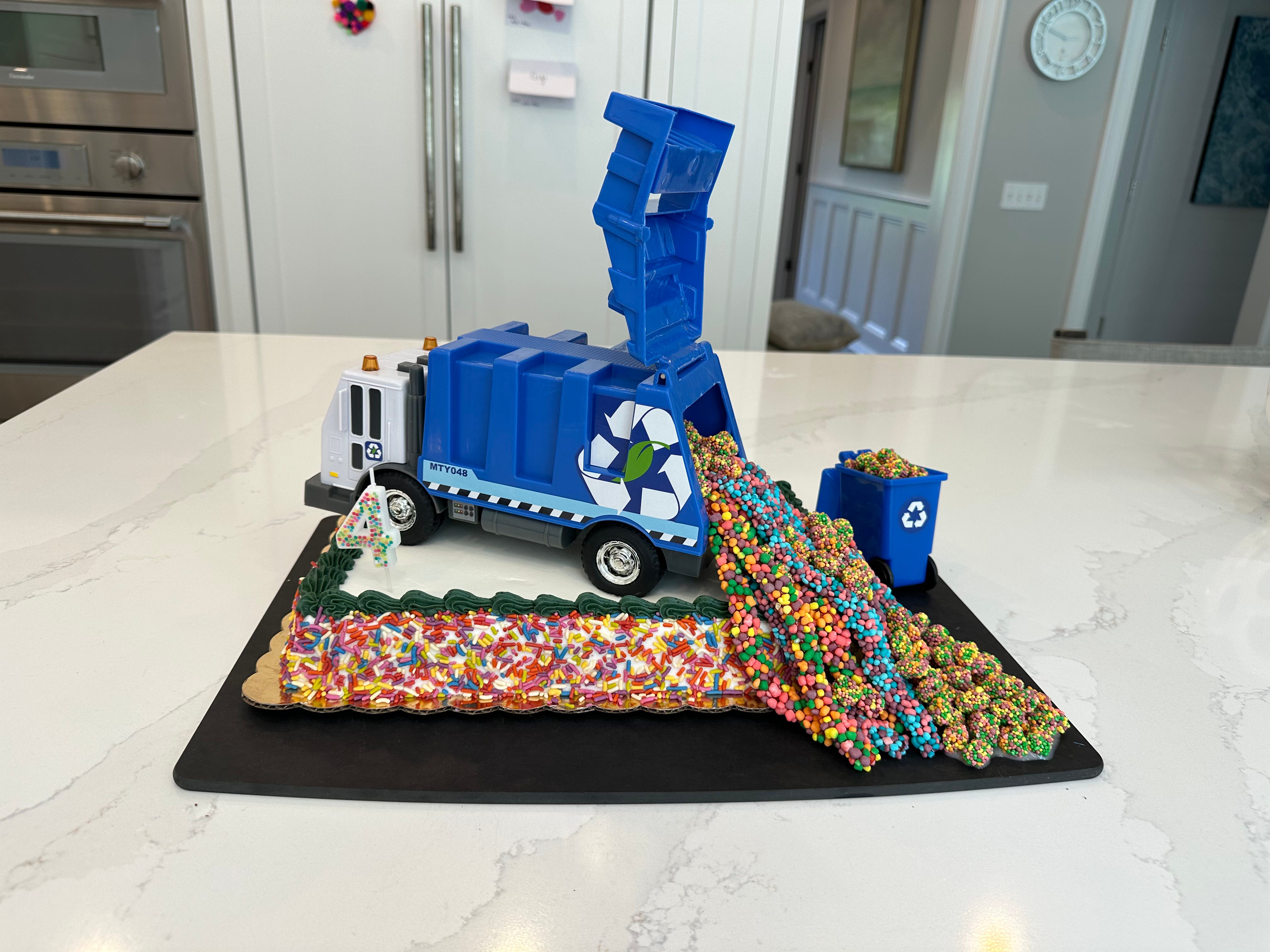
For those looking to recreate at home, here’s the recipe: (1) Ask your child repeatedly what kind of cake they want. They’ll say vanilla. (2) Ask them one last time two days before their birthday. They’ll say “a purple recycling truck cake.” (3) Panic order a blue recycling truck toy (no purple available) and Amazon’s entire stock of Nerds Rope candy. (4) Order a sheet cake from the grocery store. (5) Place recycling truck on top of sheet cake, with Nerds candy coming out of it. (6) When your child happily shouts it’s purple!, do not correct him. (7) Call yourself a chef.
My third child, and I still somehow forgot just how much time is spent at the OB-GYN during the third trimester of pregnancy. With all this essential medical care happening, when am I supposed to find the time for other essential tasks, like picking up Paw Patrol balloons?
Re: the subheadings in this post, please tell me other sapiens recognize the Hootie reference? My husband did not, but I felt it was important to include so that we all, collectively, go through our Mondays humming it to ourselves. [(Time!) is wasted, (time!) is walking, you ain’t no friend of mine…]
As income increases, feelings of time poverty increase, too. Interestingly, this may be because of something called “commodity theory.” As the authors of this Behavioral Scientist article argue: “when any resource is perceived as scarce, it is also perceived as valuable (think of water in the desert or men in pilates classes). So, when our time starts to become more financially valuable, we also view our time as being increasingly scarce.” I will say, the “men in pilates classes” reference caught me off guard. Keeping us on our toes, Behavioral Scientist!
At the risk of ruining the nice, tidy conclusion of this post, I will note that during some of those extra minutes I bought for myself, there was a surprise child vomiting situation that required cleanup. Other than that, time well spent!
Don't worry - got the Hootie reference by the "I don't believe in time" heading! :)
I loved this, and it actually gave me terms to use as I have been struggling with why, even though I am not facing the pressures of a job, children, etc. and everything on my daily to-do list are actually things I want to do, I have still feel rushed. It's a feeling of Time poverty! Perfect. I suspect being in my mid 70s has added the sense of time poverty because I am now experiencing the relatively new pressure of "I don't know how much time I have left in life to get the stories I want to write, written" and the fact that so much more of my day is spent maintaining my body so that that I have the best chance of extending that time in healthy years. But, I have recently found that scheduling time when I will not multi-task; making sure that I include blocks of time each day to just be present in nature or read for pleasure; honoring the pleasure I get when I provide service to others, etc have been helping. But now I have a word for those days when I do feel like there is enough time - Time Abundance. So thanks!