



New study on girls' social media use
What adolescent girls really think about TikTok, Snapchat, and Instagram

Big week at Techno Sapiens HQ (i.e., my couch) last week! In case you missed it: we launched paid subscriptions, you all were extremely supportive, and I finished off the week feeling very grateful. Also, I caught up on the latest Ted Lasso,1 took my toddler to his very first Easter egg hunt, and—perhaps most importantly—discovered a peanut sauce at our local Vietnamese restaurant that has forever changed me.2 It was a good week.
To keep the positive vibes going this week, paid subscriptions are 10% off. Support Techno Sapiens, get bonus subscriber-only perks, and take advantage of one more week of discounts! Thanks for your support, sapiens.
7 min read
Last year around this time, I wrote about a research report the nonprofit Common Sense Media had just released.
I believe my exact words were:
Every few years, the nonprofit Common Sense Media conducts a large, nationally representative survey of kids, ages 8 to 18. They ask about all kinds of tech use—social media, smartphones, gaming, TV, etc. And today, fellow techno sapiens, that data is here.
This is my Super Bowl.
Fast forward a few months, and I had the opportunity to be on the other side—leading Common Sense’s most recent research report on adolescent girls’ social media use.3
I’m not sure what can top a Super Bowl. A Rihanna halftime show?4 (Okay, let’s not get too ahead of ourselves). Suffice to say: it was very exciting. And now I’m excited to share the results with all of you.
Let’s dive in!
What’s the research about?
So, you know how every few minutes, you see another article about the effects of social media on girls’ mental health, or a new Twitter debate about social media and girls’ mental health?
These discussions are important, but they tend to be missing one key voice: girls themselves.
What do girls actually think about social media platforms like TikTok and Instagram? What kind of effect do they think the platforms are having on them? What are they even doing on there, anyway?
It turns out, a good way to answer these questions is to ask them directly.
What did you do?
We did a large, national survey of nearly 1,400 adolescent girls (ages 11 to 15), with a sample that matches the demographic makeup of the U.S. We did not limit the sample only to girls who use social media, but the vast majority of girls do.
Here’s how many girls said they’ve ever used certain platforms:
YouTube: 85%
TikTok: 73%
Messaging apps (like iMessage or WhatsApp): 60%
Instagram: 59%
Snapchat: 57%
Facebook: 49%
Any social media: 98%
We asked them questions about what they think of social media platforms, and how they’re spending their time online.
In most cases, the survey questions were multiple-choice. For example, when we asked girls how often they were having certain experiences on each platform, they’d choose between options like “Never,” “Once or twice per month,” “Multiple times per day,” etc.
In some cases, though, we asked them open-ended questions, so they could give us their perspective in their own words.
What this data is good for: Estimating the proportion of girls in the U.S. who say they’re having certain online experiences; getting a sense of what girls think about social media platforms.
What this data is definitely not good for: Drawing causal conclusions, like, for example, “social media causes mental health issues.” Cross-sectional, self-report surveys (even really big ones) are not good for this.
So, what did girls say?
I spent many, many hours on this study, so it’s hard for me to pick out just a few key findings.5 There’s too much interesting stuff! Alas, here is my attempt to do so (and for the rest of the findings, you can find the full report here):
How much time are they spending?
This one should come as no surprise. Among girls who’ve used each platform in the past month, here’s how much time they say they’re spending on average per day:
TikTok: 2 hours, 39 minutes
YouTube: 2 hours, 23 minutes
Snapchat: 2 hours, 1 minute
Instagram: 1 hour, 32 minutes
Messaging apps: 1 hour, 54 minutes
Note: 83% of 11- to 12-year-old girls say they have a smartphone, and 93% of 13- to 15-year-olds do.
What do they think of these platforms?
They have mixed opinions. When we asked girls whether they think each platform has had a mostly positive, mostly negative, or neutral (neither positive or negative) effect on people their age, here’s what they said:
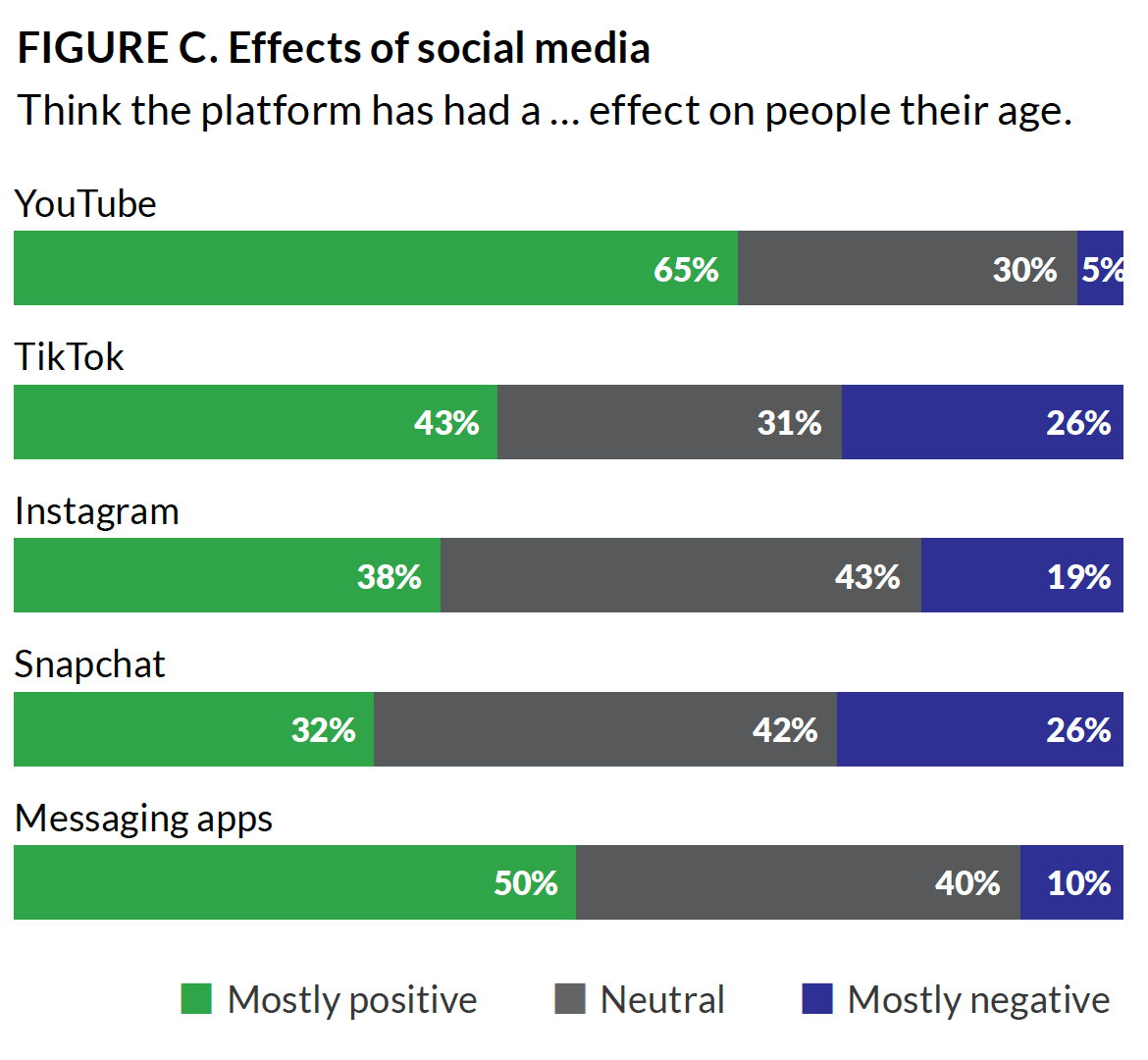
We also asked girls what they thought of specific design features, like endless scrolling (i.e, where there’s no clear endpoint to the feed) and video autoplay (i.e., when one video starts playing immediately after another ends). Girls had mixed opinions on these, too.
Of all the features we asked about, girls were mostly likely to say that location sharing and public accounts have had a “mostly negative” effect on them. In contrast, they were most likely to cite recommended videos and private messaging as having had a “mostly positive” impact on them.
Is there anything good happening on social media?
There is!
For example:
The majority of girls say they’re having positive social experiences (like staying connected to friends, getting support, or meeting new friends) at least weekly on TikTok, Instagram, or Snapchat.
46% say they explore their interests or discover new things everyday on TikTok
40% say they post things that allow them to express themselves creatively everyday on Snapchat
More than half say they come across helpful mental health information or resources at least monthly on YouTube (54%), Instagram (57%), Snapchat (52%), and TikTok (60%)
Many girls of color say they’re exposed to positive or identity-affirming content about people of their same race (e.g., 37% who use TikTok say this happens daily on the platform).6
Interestingly, many of these positive experiences were especially common among groups who we might expect to be more vulnerable, like girls with depressive symptoms, girls who are struggling in their “offline” social lives, and youth identifying as LBGTQ+.
Okay, and how about the bad stuff?
That’s definitely there, too. And some of it is...very bad. For example:
Nearly half of girls who use TikTok (45%) say they feel “addicted” to the platform or end up using it for a longer period of time than they originally planned at least once a week, as do roughly one in three who use Snapchat (37%), YouTube (34%), and Instagram (33%).
One-quarter of girls (24%) who use TikTok say that it gets in the way of their sleep every day.
Girls say they’re being exposed to suicide- and eating disorders-related content that is “upsetting” to them. Four in 10 girls who use Instagram (41%) and TikTok (39%) say they see harmful suicide-related content on these platforms at least once a month.
The majority of girls who use Instagram (58%) and Snapchat (57%) say they’ve been contacted by a stranger on these platforms in ways that make them uncomfortable.
Nearly half of girls of color who use TikTok (48%) or Instagram (48%) say they’re exposed to racist content or language on the platforms at least once a month.
And remember how we said that positive social media experiences were more common among girls who might be more vulnerable (e.g., girls with depressive symptoms, girls struggling socially, LGBTQ+ youth)? Well, the negative experiences were, unfortunately, more common in these groups, too.
For example, one of the more striking findings for me, was this one: among girls with moderate or severe depressive symptoms, about 7 in 10 say they’re coming across harmful suicide-related content at least monthly on Instagram (75%), TikTok (69%), Snapchat (64%), or YouTube (64%).
There’s no getting around it: these things are really problematic, and we need to figure out how to fix them.
How would girls make social media better?
In one of my favorite parts of the survey, we asked girls to tell us, in their own words, how they would change each platform to make it better for teens’ well-being.
Here were the most common responses:
Add age limits or restrictions, including more age-appropriate content and preventing adults from contacting minors.
For example, one 15-year-old suggested that Instagram “make some of the adult content not available to see without parent consent.”
Of Snapchat, a 13-year-old suggested the platform make it so “adults can’t add us kids.”
Better manage content and privacy options, including improvements to privacy settings, and making it easier to block or filter content.
“Filter accounts with inappropriate content better,” suggested an 11-year-old of YouTube.
Of Snapchat, a 14-year-old said, “If I could make one change to Snapchat to make it better for teens, I would add more security features.”
Promote more positive content, including removing hateful or violent content and providing more positive mental health resources.
“I would have them remove videos that are harmful and dangerous,” said a 14-year-old of TikTok, “like all the challenges that destroy stuff in schools or hurt other people.”
Key takeaways
Social media is playing a major role in girls’ lives—for better, and for worse. Interestingly, girls who are especially vulnerable may be seeing both more of the risks and more of the benefits.
Girls say social media has important upsides, like connecting with friends, discovering new things, and accessing resources and support.
But they see the risks, too. Frankly, those risks shouldn’t be happening. TikTok should not be getting in the way of sleep every night for one-quarter of the girls who use it. Three-quarters of girls who are already struggling with significant depressive symptoms should not be seeing suicide-related content on Instagram every month.
Now, our challenge is to figure out how to fix social media. Maybe we should start by asking girls themselves.
A quick survey
What did you think of this week’s Techno Sapiens? Your feedback helps me make this better. Thanks!
The Best | Great | Good | Meh | The Worst
I love Ted Lasso. So what if critics say this season is “unsure where to go,” “clumsy,” or “amiss figuring out what kind of show it wants to be”? Not listening. Don’t care. Would watch 100 more episodes. Ted explaining Hallmark Christmas movies to Roy is exactly what I need in my life right now.
I do not know what was in this peanut sauce, but—not to be dramatic—I think it changed my life? It was the perfect combo of salty and sweet. Great texture. Little bits of peanuts in there, which is, obviously, non-negotiable. I also have a mild shellfish allergy, but ate this sauce on a shrimp summer roll (YOLO) and felt fine? Did this peanut sauce cure my allergy? What can’t it do?
Full citation: Nesi, J., Mann, S. and Robb, M. B. (2023). Teens and mental health: How girls really feel about social media. San Francisco, CA: Common Sense.
According to Carrie Battan in The New Yorker: “Rihanna is perhaps the only pop star so relaxed and unencumbered by expectations that she could turn such a high-stakes occasion into a jaunt.” We are not worthy!
How can I pick a favorite finding from this research? I don’t have a favorite finding. Each of the findings is special to me in its own, unique way. I mean, a new finding could never replace my love for a first or second finding. I’ll definitely try to find just 10 minutes a day or so to have special one-on-one time with each finding so it doesn’t feel left out, but it’s hard because the other findings also just require so much attention…
A few clarifications. (1) “Girls of color” refer to those who identify as Black, Hispanic, Asian, more than one race, or another race besides White. (2) Percentages reported for positive and negative social media experiences are only among girls who use each platform. In other words, we only asked girls how often they were having an experience on, say, TikTok, if they use TikTok. This is because it would have been weird and very repetitive to ask a girl 22 questions about how often they have an experience on TikTok if they’ve never used the platform. (3) For time spent, we asked girls how much time they’d spent on each platform yesterday. This still has the problems of self-report (i.e., we’re bad at reporting how much time we spend online), but is slightly better than asking, in general, how much time they spend on average. (4) We defined social media broadly as tools that allow teens to both create and consume content (this is why YouTube, for example, is included). We focused our analyses on the most popular platforms: TikTok, Snapchat, YouTube, Instagram, and messaging apps.
In case you missed it
Techno Sapiens shoutout in the New York Times!
My interview with On the Media (WNYC)
As a pediatrician, I really struggle with the belief that access to mental health information and resources and information is all positive. I have countless typically-developing teenagers (mostly girls) coming to me wondering if they have autism or ADHD because of information they have encountered on TikTok. I also have teenagers coming to me talking about how they are “dissociating,” a term which, as far as I can tell, they are learning online. You can’t all be dissociating at once, people! I am also wondering about whether kids who are truly in the thick of social media can really discern what is good or bad. Like if you have an eating disorder, perhaps it is helpful and positive to learn techniques online, and you do not entirely have the perspective to know that social media is negatively perpetuating your disease. I’m all for hearing the kids’ perspective, but these are still kids, and I don’t think they all have the ability to objectively know what is good or bad for them, especially in the long term.
Thanks for reporting on this. I recently wrote a post 'TikTok brain cure with three ingredients' https://schooloftheunconformed.substack.com/p/tiktok-brain-cure-with-three-ingredients which focuses on the role that school, parents, and 'getting real' can play in helping youth stay grounded in reality. While girls may report 'positive experiences', the amount of time spent on digital devices is eating away from time that used to be spent in real-life relationships and activities. Thus I think it is less about fixing social media and more about weaning off devices and apps that are specifically designed to exploit addictive tendencies.