

Planning a digital detox?
Read this first.

Happy new year, sapiens! I’m back from maternity leave,1 which means we’re returning to our usual Monday morning publishing schedule. Hooray!
I don’t know what’s happening in your home, but here at Techno Sapiens HQ, we’re entering our fifth consecutive week of children coughing and sneezing. Spit up is staining our clothes and stray bits of wrapping paper are littering our floors. Our dinners are a strange, harried mix of leftover noodles and Bûche de Noël.2 Each day ends with my husband and I lying on the couch, staring wide-eyed and shell-shocked at the ceiling.
But that won’t stop us from taking on 2026, will it? (It might).
For those who are new here, I’m Jacqueline Nesi, a psychologist, professor, and mom of three.
For those who have been here awhile, hello! I missed you!
I am so excited to be returning to Techno Sapiens, and so thankful to you all for being here.
5 min read
It’s that time of year! The people are digital detoxing, the media outlets are bursting with tips for unplugging, the Substack feeds are 90% viral pieces about ditching smartphones for crochet needles.3
It’s January, and that means it’s time to kick our scrolling habits to the curb once and for all!
Now, don’t get me wrong. This is Techno Sapiens, and you know I love a tech-related resolution as much as anyone.4 However, I’m seeing a lot of “digital detoxing” content where the entire strategy seems to boil down to a kind of reverse Nike slogan: Just (Don’t) Do It.
My sense is that this is unlikely to be effective.
So, what can we do to set ourselves up for success? How can we set “digital detox” goals that actually stick? Research on goal-setting suggests it’s worth taking a step back to consider what, exactly, we want to limit, why we want to do it, and how we plan to accomplish it.
Oh, what’s that you say? A team of Belgian researchers recently published a highly detailed, evidence-based framework for helping us do just that? What luck!
Digital detox, but make it ~*science*~
Now, as we dig into this framework, I am both delighted and sorry to inform you that we’ve got a classic case here of scientists being scientists.5
Lots of studies cited, lots of large tables with headings like “socio-cultural assumptions” and “momentary subjective experience,” a figure that looks like this:
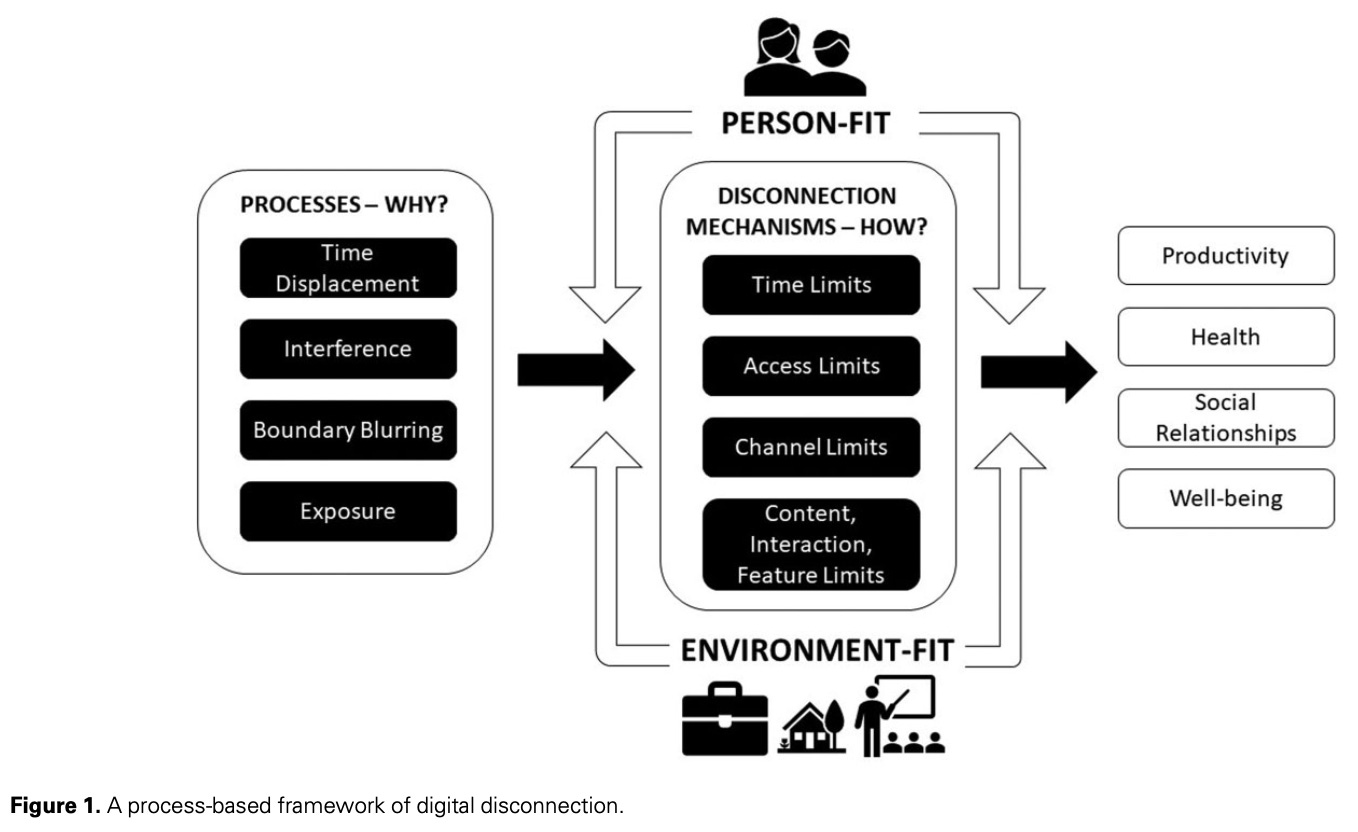
But we are techno sapiens! And we are not deterred!
Let’s break down what this means and how it can help us on our digital detox journeys.
First things first. The authors use the term “digital disconnection” instead of “digital detox.”
Here’s the definition of digital disconnection:
“A deliberate form of non-use of devices, platforms, features, interactions, and/or messages that varies in frequency and duration with the aim of restoring or improving one’s perceived overuse, social interactions, psychological well-being, productivity, privacy and/or perceived usefulness.”
Did you just black out? No problem.
This translates simply to: reducing some aspect of your tech use to feel better.
A “digital detox” is one extreme form of digital disconnection, which involves fully quitting a device or platform(s).
Choose your own digital disconnection adventure
Now, onto the good stuff.
The researchers identify four major harms that people may be experiencing from their digital lives and offer digital disconnection strategies to mitigate each of those harms.
I hope these can help guide your personal digital disconnection journey.
Harm #1: Time displacement
What it is
This is an issue of quantity of use, where screen time gets in the way of other activities a person might rather be doing (e.g., sleeping, face-to-face interactions, crocheting).
How it feels
I end up spending more time on my device than I want to. I don’t have time to do the other things I want to do. I lose track of time while using my device.
How to fix it
Set low time limits on overall device use using your phone’s screen time settings.
Charge your phone outside of your bedroom at night.
Block (or delete) certain apps or platforms, either all the time or during certain windows. You can use apps like Freedom or Opal, tools like the Brick, or even trade your smartphone for one with limited features, like the Light Phone or a flip phone.
Have other activities ready! Figure out what your screen time is “displacing”—your goal should not just be “less phone use,” but also “more other stuff.”
Check your beliefs. Does all time need to be spent “productively”? What does that mean to you?
Harm #2: Interference
What it is
Whereas displacement is about the overall quantity of use, interference is about short interruptions throughout the day that affect our attention and focus.
How it feels
I’m constantly distracted by my device. I feel overwhelmed by disruptions. I cannot focus on one thing (work, talking to my spouse, hanging out with my kids) for any length of time.
How to fix it
Break the phone-checking habit by creating friction to accessing it.
Technical ways to create friction: move apps around on your device, delete apps, remove facial recognition for unlocking, turn off notifications,6 put your phone on “grayscale”
Physical ways to create friction: put your device out of sight! In a drawer or cabinet, in another room, at the bottom of your bag.7
Put your phone on “Do Not Disturb” during activities like working, driving, spending time with family, etc.
Check your beliefs. From the authors: “giving into digital distractions may often be a relatively benign form of waxing-and-waning that occurs during task performance for most individuals.” In other words: we all get distracted sometimes, and that’s okay. Recognize when it’s truly becoming a problem, and try not to be too hard on yourself!
Harm #3: Boundary blurring
What it is
Constant connectivity leads to being “always on,” reducing the boundaries between our various “roles” as parents, employees, friends, and partners.
How it feels
I bring work home with me and can never shut it off. And when I’m at work, I’m bringing home life with me—responding to messages from my child’s school, coordinating childcare, texting my husband “Remember it’s ‘bring something that starts with the letter Q’ day at preschool,” etc.
How to fix it
Unfortunately, much of this is dependent on some larger systems that are outside your control (your workplace, your child’s school), so certain solutions may be more possible than others for you. Some ideas:
Make boundaries between work and home less “permeable” by using separate devices, apps, or email accounts for work
Create “micro-boundaries” by setting out-of-office replies, and disabling notifications from work emails or Slack
Check email during designated times (“email batching”) versus throughout the day
If you have a partner, try to divide school and childcare communication duties in a way that works for both of you
Harm #4: Exposure
What it is
Our use of devices (and social media in particular) exposes us to content that makes us feel bad emotionally, or our time on devices creates physical discomfort (e.g., “Zoom fatigue,” headaches, neck pain)
How it feels
I feel bad about myself after scrolling Instagram. I feel anxious after “doom scrolling” the news. I feel physically uncomfortable after spending too much time online.
How to fix it
Personalize what you see on social media. In your Instagram settings, for example, you can: select topics you want to see more of, designate people as Favorites so they appear higher on your feed, and limit “sensitive” or “political” content
You can also prune your social media feeds by unfollowing accounts, blocking certain hashtags or keywords, and hiding “like” and “share” counts.
For the physical effects: reduce time (see above), and take frequent breaks from staring at screens. To reduce Zoom fatigue, turn off “self-view,” so you’re no longer staring at your own video.
What digital disconnection strategies are you trying this year? Let us know in the comments!
A quick survey
What did you think of this week’s Techno Sapiens? Your feedback helps me make this better. Thank you!
The Best | Great | Good | Meh | The Worst
It feels like so much has happened while I was out, but also so little? What did I do? Let’s see…preschool dropoffs and pickups, a lot of car seat reshuffling and installing, delivered a new human life into the world, wiped many runny noses, made mooing sounds inches from my baby’s face until she giggled, reflected on my relationship to work and motherhood and the delicate, impossible balance of it all. Yup, that’s about it!
The Bûche de Noël (i.e., yule log cake) was originally supposed to serve my entire 20+ person family, who came into town for the holidays. After a bout of illness took down the majority of those in attendance, we were left with it. Over the subsequent week, my husband and I ate so much of this godforsaken cake that it became a verb (“Are we Bûche-ing tonight?” “You ready to Bûche?”). It was delicious.
What is it about Substack people and digital detoxing? This might just be my algorithm, but at this point, my Notes feed is entirely first-person accounts of people throwing away their smartphones, going off the grid, and subsisting solely on homemade sourdough, crafting supplies, and feelings of moral superiority.
As you may remember from a Techno Sapiens post titled “In defense of New Year’s resolutions,” I love resolutions!
My personal “digital disconnection” resolutions this year include: charging my phone outside my bedroom, blocking social media apps during the day, and putting my phone out of sight while I’m with my kids. Also, turning off Zoom “self-view” because after a few months away, it’s alarming to see so much of my own face.
To be clear: this is not a criticism. We love scientists! Even my 4-year-old is now saying he wants to be a scientist when he grows up. Although, when I told him I was a scientist and tried to explain the research I’m doing (“I, uh, ask people questions about how they use technology? And their feelings? And sometimes they do special games on a computer?”), he looked at me with profound disappointment and replied, “Mom, that’s not a science experiment.” Praying he does not contact NIH.
In terms of turning off notifications: research suggests that for some people, disabling notifications can actually lead to more phone-checking behavior, because they are worried they are going to miss out on something important or interesting. So, experiment with this to see what works for you. (I prefer to disable all notifications except text messages and, of course, food delivery apps).
Alternatively, leave your phone around the house for your toddler to grab and hide. Very effective.
Thank you, this was very interesting! I think it was the first time I read someone mention how we parents are not really able to log off completely due to school communication and that we are always assumed to be available and reachable. I recently read a fascinating study about how the mere presence of our phone in the room distracts us tremendously. It’s kind of like always expecting the mailman to ring the bell. Did you know that kids have a similar issue with toy clutter? In Germany “toy detox” has been established for decades to help kids reset. (I wrote about it here: https://scientistmom1.substack.com/p/is-a-cluttered-playroom-the-toddler )
Love this and welcome back! So much of the digital detox talk misses some key points here, what a great resource.